July 19, 2019

Blog

The Future of Modelling and Simulations in Pharmacometrics with Julia

This is a repost from an ISoP newsletter item

By Vijay Ivaturi, Chris Rackauckas, Viral B. Shah

Pharmacometricians have been early adopters of mathematical programming tools. We use tools that allow us to solve real problems. However, given the diversity of problems that we solve, our field has seen a split in the languages that we use due to the problems they are tailored to solve. R has become a staple in the community due to its strong statistics, data manipulation and plotting libraries. MATLAB and its ODE solvers have been the basis for many QsP models. The NLME community is still very much rooted in more traditional tools like FORTRAN, while machine learning is leading some researchers to explore Python.

While having a swiss army knife helps, an alarming trend in this field is the language split between the package developers and users. Pharmacometrics is a discipline where we need to know that the code we are running is doing what the mathematics says, and we need to validate everything. However, the libraries that we are calling are generally written in other languages and treated as an undebuggable black-box. If you're interested in adding a hook in R's deSolve ODE solvers for some new QsP model, or want to dig in and find out why Stan's Bayesian estimation is missing a peak, you will not find R code. Instead, you will find that the core of these libraries are written in FORTRAN 77/90 and C++, and investigating what they are doing requires using opaque and non-interactive languages. This is a requirement because writing low-level code was a traditional requirement for higher speed. Smart programmers who know how to work with SIMD vectorizers, stack-allocation of volatile structs (and how they are sometimes miscompiled), and pointer tricks on mutable buffers compile a binary that the interactive language calls and the details of the algorithm are intertwined with a computer science degree. This is done because the performance difference is not small, and one can easily get performance increases of 10x-1000x by utilizing these "close to the metal" features to optimize the implementation of their underlying loops.

While the efforts of these impressive programs and their programmers are laudable, this split between "languages used to write packages" and "languages used to do science" is not a sustainable way to build a fast, usable, and verifiable scientific computing ecosystem. This is the problem that Julia solves. Code written in Julia is as fast as C or Fortran while being dynamic and interactive like R and MATLAB. Julia achieves this by reengineering what it is to be a high-level language from the ground up, using a type-based multiple-dispatch system that cannot easily be applied to fix languages like R, Python, or MATLAB. This means that a scientific computing ecosystem has been built from scratch to have Julia code all the way down without losing performance. There are thus three things that are gained by using Julia for scientific computing: its user-developer connection, it's diverse ecosystem which has quickly grown due to the ease of development, and the speed of its packages.

The user-developer connection is an invaluable asset when working in Julia. One could be just a researcher using packages developed by others, but can very easily, e..g. use @edit on a plot that would open up the Julia file in the library and add their own features in. Within hours one goes from a user to a "package developer". As this barrier between users and developers is so small, the developers are all there in the user communities. The support system that thus exists in the Julia Slack and Discourse is unparalleled due to the fact that many times your questions will be answered by people who not only know how to use the package but also know the code. The number of people verifying obscure edge cases is also increased when every user is one line away from checking a code that's in a language they know. This has allowed Julia to grow to have a very well-connected package ecosystem because it's easy to make packages talk to each other since we are all using the same underlying language: Julia.

The connectedness and ease of development have allowed Julia to grow to have one of the most diverse and feature-rich package ecosystems. Julia packages are some of the most advanced in differential equations, statistics, and machine learning. One of the central packages for pharmacometrics in Julia is DifferentialEquations.jl. This software ecosystem is undergoing [continual advances(http://juliadiffeq.org/news/index.html)] in the areas of parallelism (multithreaded, distributed, and GPU), improved solver strategies like IMEX and exponential integrators, along with advancing the methodologies in new mathematical modeling areas like delay differential equations (DDEs), stochastic differential equations (SDEs), and jump equations (Gillespie). All of the tricks, like adjoint sensitivity analysis for parameter estimation, mixing differential equations into neural networks, automatic symbolic calculation of Jacobians, etc. are all supported by this one library, making it both faster than the traditional libraries while being easier to use for modern modeling practice.

In the statistical libraries, packages like DataFrames.jl, Distributions.jl, and MixedModels.jl are stunning counterparts to the R ecosystem. In fact, MixedModels.jl was developed by the same author as lme4 (Douglas Bates), who now requests users of lme4 to use JuliaCall to call MixedModels.jl from R since the Julia package has both better convergence properties and runs 30x faster. While on the machine learning side, machine learning libraries like Flux.jl and MLJ.jl give full-featured learning pipelines in ways that allow for GPUs and other acceleration opportunities.

And the pivotal feature, in the end, is the speed. The differential equation solvers have the most comprehensive set of benchmarks found at DiffEqBenchmarks.jl and its unique algorithms routinely beat classic C++ and Fortran methods. Users coming from R, Python, and MATLAB routinely report speedups, averaging at around 30x before optimizing the code. For example, this was recently demonstrated on a cardiac QsP model from Pfizer (26x), on a battery efficiency differential-algebraic equation model at Carnegie Melon (30x), and on the test suite at MATLABDiffEq.jl. In cases where there are no similar algorithms in other packages, like high order adaptive stochastic differential equation integrators, the difference is even more dramatic, with a stochastic epithelial-mesenchymal transition model (EMT) besting the standard methods by ~3000x.

Speed itself is a feature that enables models. By being faster and easily parallel, the size of the model can continue to increase and new domains can be explored. This is the central idea behind Pumas.jl, which is a soon to be released pharmacometric modeling suite in Julia. Building off of DifferentialEquations.jl, it allows for the large ODE models of PBPK and QsP models, while allowing nonlinear mixed effects (NLME) population models. The simulation methods can make use of these special GPU-accelerated high order ODE/SDE/DAE/DDE/etc. solvers to enable pharmacometricians to start exploring entirely new models. This is coupled with the ability to do parameter estimation through maximum likelihood and Bayesian methods (HMC and SAEM). A connected suite for bioequivalence and NCA allows one to integrate the whole simulation and estimation pipeline, and the connectedness to the existing Julia package ecosystem allows for one to swap in global optimizers, automatic differentiation, and uncertainty quantification.

Julia is written for scientific computing and its vibrant community involves mathematicians, statisticians, software engineers, and life-science majors. The Pharmacometrics community has mostly revolved around clinicians, pharmacists, life-science majors and consists of very few highly technical scientists from an engineering or mathematical background. Julia in pharmacometrics will provide an opportunity to make our community more inclusive and bring innovation and efficiency that is otherwise left at the mercy of the develop-user split. We are hopeful.
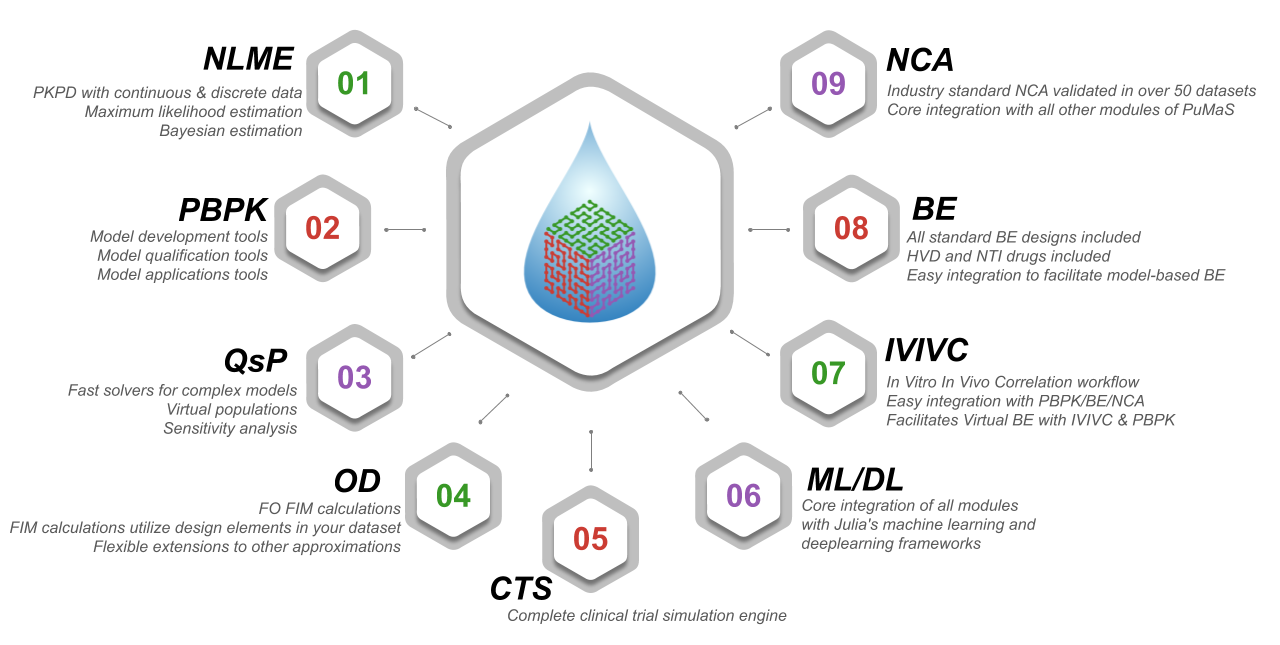
Pumas Products Image


twitter

In other News...

BLOG
A Journey of Passion and Innovation: Launching DeepPumas and AskPumasIn the world of tech, product launches are usually accompanied by discussions about cutting-edge algorithms, sleek interfaces, and revolutionary breakthroughs. But for me, the story of DeepPumas and AskPumas is not just about the technology—it’s about the people. It’s about how a global team, spread across 18 countries, came together to build something extraordinary.

In other News...

BLOG
AskPumas Surpasses 15,000 Questions Answered as Global Use of AI Tools in Drug Development AcceleratesAskPumas, our secure Retrieval Augmented Generation (RAG) tool built for clinical pharmacologists and pharmacometricians, has just surpassed 15,000 questions answered. AskPumas is an AI assistant that delivers trusted, on-demand access to field-specific knowledge by integrating a curated list of sources, giving pharmacometricians...

In other News...

BLOG
Collaborative work by Pumas-AI and Otsuka to be presented at NKF '21We are excited to announce that the collaborative work performed by Otsuka Pharmaceutical Development & Commercialization and Pumas-AI scientists will be presented at National Kidney Foundation 2021 on April 6-10, 2021! The modeling used Pumas software to explore urine osmolality and GFR relationship. Urine Osmolality (Uosm) Is a Reasonable Marker of Acute (TKV) and Longer-term...

In other News...

BLOG
Congrats to Dr. Rackauckas – awarded 2020 ISoP Emerging Scientist!Dr. Christopher Rackauckas, our Director of Scientific Research, was recently awarded for the 2020 ISoP Emerging Scientist Award. The International Society of Pharmacometrics (ISoP) Awards Ceremony was hosted by the Eleventh American Conference of Pharmacometrics (ACoP11) on Monday, November 9, 2020. The Emerging Scientist Award, the highest early career award given by ISoP, was granted to...

In other News...

BLOG
Dr. Vijay Ivaturi Announced as New Chief Executive Officer at PumasAIThe PumasAI Board of Directors are pleased to announce that, effective Jan 1, 2024, Dr. Vijay Ivaturi will be stepping into the role of Chief Executive Officer, succeeding Dr. Joga Gobburu. After four years of dedicated leadership, Dr. Gobburu will be transitioning from his current role as CEO to the position of Chairman of the Board of PumasAI. Dr. Ivaturi brings a wealth of experience...

In other News...

BLOG
Former BMS Quality Director Joins Pumas-AI Scientists as Head of Quality Assurance and Compliance Amid 3X Growth PeriodPumas-AI, a science-first organization that turns data into life-saving decisions faster, announced today that Peter J. Miller has joined the organization as Head of Quality Assurance and Compliance. In his role, Mr. Miller will further strengthen and build upon the quality of deliverables and products that Pumas-AI scientists produce, including clinical pharmacology, pharmacometrics...

In other News...

BLOG
Former Bristol-Myers Squibb Head of Pharmacometrics Dr. Amit Roy Joins PumasAI to Support Drug Development Programs and DeepPumas ApplicationPumasAI, a science-first organization that turns data into life-saving decisions faster, announced today that Dr. Amit Roy, former Executive Director and Head of Pharmacometrics at Bristol-Myers Squibb (BMS), has joined PumasAI as Distinguished Scientist. In his new role, Dr. Roy will contribute to PumasAI’s growth trajectory by providing model-informed drug development (MIDD) expertise to accelerate drug development programs...

In other News...

BLOG
How Machine Learning Will Change the Future of Pharmaceuticals: Q&A with CEO Joga GobburuThe machine learning market is estimated to be worth a staggering $106.52 billion by the year 2030, according to Market Research Future. Combine this with the rise of consumer interest in artificial intelligence (AI) tools like ChatGPT, the world is beginning to mainstream these technologies. As this occurs, scientists are developing tools to level-up drug development analytics to create stronger outcomes and potentially save more lives...

In other News...

BLOG
International Society of Pharmacometrics Names Pumas-AI Co-Founder Dr. Vijay Ivaturi as President-ElectCo-Founder and Chief Scientific Officer (CSO) Vijay Ivaturi, PhD, has been elected as the next President of the International Society of Pharmacometrics (ISoP). Dr. Ivaturi will serve a one-year term as President-Elect effective immediately and will assume the ISoP presidency in January 2024, for a two-year term. As President-Elect, Dr. Ivaturi will oversee the development of ISoP’s three-year strategic plan...

In other News...

BLOG
Model-Informed Drug Development: Everything You Need to KnowAccording to the U.S. Food & Drug Administration (FDA), “model-informed drug development (MIDD) is an approach that involves developing and applying exposure-based, biological and statistical models derived from preclinical and clinical data sources to inform drug development and decision-making.” In 2018, the FDA created a pilot program to explore MIDD further...

In other News...

BLOG
New Clinical Pharmacology Desktop Software Launched by Pumas-AI is Easier to Use and Compliant with Global RegulationsPumas-AI, a science-first organization that turns data into life-saving decisions faster, announced today that it has launched Pumas-CP - a new clinical pharmacology platform for non-compartmental analysis (NCA), bioequivalence analysis, and pharmacokinetic and pharmacodynamic (PK/PD) modeling. “Pharmacokineticists and clinical pharmacologists are looking for a simple tool to manage...

In other News...

BLOG
New Three-Phase Course from PumasAI and SOPHAS on AI in Drug Development Set to Launch this OctoberPumasAI announced its partnership with SOPHAS (Society of Pharmacometrics and Health Analytics) to launch a new course aimed at empowering the next generation of scientists and healthcare professionals with practical knowledge on Artificial Intelligence in Drug Development (AIDD). This will be the first of many such courses being offered through this partnership.

In other News...

BLOG
Pharmacometrician Receives Lewis B. Sheiner Lecturer Award for Outstanding Lifetime AchievementsJoga Gobburu, PhD, a professor in the Department of Practice, Sciences, and Health Outcomes Research (P-SHOR) and director of the Center for Translational Medicine (CTM), received the Lewis B. Sheiner Lecturer Award, the highest recognition from ISoP on Nov. 5 at the society’s annual meeting at the National Harbor in Maryland.

In other News...

BLOG
Powerful Pumas Software is Now Available for Desktop DownloadPumas-AI, a science-first organization that turns data into life-saving decisions faster, announced today that its Pumas software is now available for desktop download. Pumas is a one-stop integrated modeling and simulation platform designed to multiply productivity across the drug development lifecycle, turning data into life-saving decisions faster.

In other News...

BLOG
Pumas 2.8 Sets a New Standard for Clinical Pharmacology and Pharmacometrics Technology with Embedded AI and Next Generation EstimationPumasAI announced the release of Pumas version 2.8 to bring significant advancements in clinical pharmacology and pharmacometrics. The latest version integrates the recently launched PumasAide, enabling artificial intelligence (AI) coding agents to connect directly to live Pumas sessions, alongside powerful new estimation methods and expanded modeling capabilities.

In other News...

BLOG
Pumas-AI Continues to Expand Pharmaceutical Pharmacokinetics and Clinical Pharmacology Expertise with New Head of Business DevelopmentPumas-AI, a science-first organization that turns data into life-saving decisions faster, announced today that Dhanashri Gudi, Ph.D. has joined the company’s senior leadership team as Head of Business Development to continue to drive the year-over-year double-digit growth that Pumas-AI has experienced since inception. Dr. Gudi has spent nearly 20 years in the pharmaceutical industry, focused on drug metabolism...

In other News...

BLOG
Pumas-AI Hires Dr. Salim Bouchene and Expands Consulting Practice in EuropeThis new hire highlights expansions that Pumas-AI has made across the globe in recent years. As a senior scientist, Dr. Bouchene will focus on modeling and simulation and their application to pharmaceutical drug development. He will support Pumas-AI’s global client base through pharmacometrics and clinical pharmacology consulting, PK/PD modeling of clinical and preclinical data across various therapeutic areas...

In other News...

BLOG
Pumas-AI Launches Julia Language-Based Software to Advance Drug Development, Patient CarePumas-AI – a new company established by University of Maryland School of Pharmacy faculty members Vijay Ivaturi, PhD, assistant professor in the Department of Pharmacy Practice and Science (PPS), and Joga Gobburu, PhD, MBA, professor in PPS – is proud to announce the release of its first cutting-edge software platform for pharmaceutical researchers and clinicians. Known as Pharmaceutical...

In other News...

BLOG
Pumas-AI looks to democratize access to drug development toolsThe University of Maryland, Baltimore startup recently completed a big upgrade for its 2.0 version. Here's why the cofounders say it matters for science, and healthcare. For the cofounders of University of Maryland, Baltimore startup Pumas-AI, technology has the power to democratize access to advanced tools. The startup’s pharmaceutical modeling and simulation platform has two products...

In other News...

BLOG
PumasAI Brings AI, Scientific Machine Learning and Advanced Pharmacometric Research to ACoP 2026PumasAI announced its scientific program for the American Conference on Pharmacometrics (ACoP 2026), taking place October 11-14, 2026, at the Gaylord National Resort & Convention Center in Maryland.

In other News...

BLOG
PumasAI Helps Launch India's First Computational Lab for Quantitative Sciences to Advance AI in Drug DevelopmentPumasAI announced its role in helping to establish the Dr. Ramalingam Sankaran Computational Lab for Quantitative Sciences at PSG Institute of Medical Sciences and Research (PSGIMSR) in Coimbatore, India. Developed through a collaboration between...

In other News...

BLOG
PumasAI is Set to Revolutionize Pharmacometrics and Clinical Pharmacology with the Launch of AskPumas and DeepPumasPumasAI, a science-first organization dedicated to empowering innovation in drug development, today announced the launch of two transformative products: AskPumas and DeepPumas. Representing the first-ever intersection of AI and biosimulation, these tools are engineered to redefine pharmacometrics, clinical pharmacology, and data science. With unprecedented predictive capabilities...

In other News...

BLOG
PumasAI Launches New Clinical Pharmacology Webinar Series Showcasing End-to-End AI-Powered PK AnalysisPumasAI today announced the launch of PumasCP End-to-End, a new four-part educational webinar series designed to help clinical pharmacology professionals streamline pharmacokinetic (PK) analyses through a single reproducible environment enhanced with artificial intelligence (AI).

In other News...

BLOG
PumasAI Launches New Enterprise AI Transformation Service That is Proven to Help Pharmaceutical Teams Achieve 50% Productivity GrowthPumasAI today announced the launch of Catalyst, a new enterprise AI transformation service built to help pharmaceutical and biotech organizations achieve up to 50 percent productivity growth within 12 months through smarter AI adoption...

In other News...

BLOG
PumasAI Maintains Strong Growth Trajectory with New Product Engineering and Pharmacometrics Hires from JuliaHub and PfizerPumasAI, a pioneering organization at the forefront of transforming data into life-saving decisions with remarkable speed, is proud to announce the appointment of two distinguished leaders to its team. These strategic hires illustrate PumasAI’s dedication to accelerating the translation of complex data into impactful, life-saving strategies and solutions...

In other News...

BLOG
PumasAI Named Best Clinical Pharmacology Tech Innovator 2025 by Global Health and Pharma for the Second Year in a RowPumasAI announced today that it has been named Best Clinical Pharmacology Tech Innovator by Global Health and Pharma (GHP) in its Healthcare and Pharmaceutical Awards 2025 program. This marks the second year in a row that PumasAI has received this honor by the media publication.

In other News...

BLOG
PumasAI Named Best Clinical Pharmacology Technology Development Firm in Biotechnology AwardsPumasAI, a science-first organization and a trailblazer in clinical pharmacology technology, has been honored as the “Best Clinical Pharmacology Technology Development Firm” at the prestigious Biotechnology Awards, hosted by Global Health & Pharma. This accolade highlights PumasAI’s significant contributions to the pharmaceutical industry through its innovative approach and dedication

In other News...

BLOG
PumasAI Named Clinical Pharmacology & Pharmacometrics Innovator of the Year 2026 by Global Health & Pharma NewsPumasAI announced today that it has been named Clinical Pharmacology & Pharmacometrics Innovator of the Year 2026 by Global Health & Pharma (GHP) News as part of its annual Healthcare and Pharmaceutical Awards program. The recognition marks the third consecutive year that

In other News...

BLOG
PumasAI Now Offering its Modeling and Simulation Software Free to Academic Research InstitutionsPumas-AI Inc, a science-first organization that turns data into life-saving decisions faster, announced today that it is now opening its powerful modeling and simulation software to all global academic institutions and researchers free of charge. This pro-bono program provides the use of the Pumas® tool, a high-performance analytical software suite that allows users to perform all pharmaceutical modeling and...

In other News...

BLOG
PumasAI Unveils PumasAide, a Built-In AI Assistant to Accelerate Pharmacometric ResearchPumasAI has launched PumasAide, which connects the AI coding agent you already use directly to a live Pumas session. Working inside the IDE, it lets that agent analyze data, generate code, and run routine clinical pharmacology tasks against live models.

In other News...

BLOG
Q&A: Calling Oncology Trials Early - How DeepPumas Predicts NSCLC Outcomes From Interim DataIn this Q&A, we speak with Mohamed Tarek, PhD, Senior Product Engineer at PumasAI, about a recent application of DeepPumas: a joint tumor growth dynamics (TGD) and overall survival (OS) model for non-small cell lung cancer (NSCLC) that lets sponsors classify ongoing trials as likely successful or unsuccessful using only early interim data, well before traditional OS endpoints would be readable. Built on the DeepNLME framework and developed in close collaboration with scientists at Bristol Myers Squibb (BMS), the model came together in two phases: Mohamed laid much of the groundwork in 2023 and presented the first phase at ACoP 2024; his colleague Lorenzo Contento led the second phase, which was recently accepted as an oral presentation at PAGE 2026 in Dubrovnik, Croatia.

In other News...

BLOG
Researchers establish Pumas-AI, launch Pumas pharmaceutical softwarePumas-AI, a new company established by University of Maryland School of Pharmacy faculty members Vijay Ivaturi, PhD, assistant professor in the Department of Pharmacy Practice and Science, and Joga Gobburu, PhD, MBA, professor in the department, is proud to announce the release of its first...

In other News...

BLOG
The story of PumasAt the outset, I would like to acknowledge and thank all those who contributed to development of Pumas. Here is a complete list in no particular order: Chris Rackauckas; Simon Byrne; Andreas Noack; Patrick Mogensen; José Bayoán Santiago Calderón; Yingbo Ma; Vaibhav Dixit; Xingjian Guo...

In other News...

BLOG
UMB-born startup launches pharmaceutical modeling platform Pumas 1.0A startup launched out by faculty at University of Maryland, Baltimore and MIT researchers collaborated to launch Pumas 1.0, a predictive analytics platform that aids in the development cycle of pharmaceutical drugs. What that means is Pumas 1.0 takes the data a drug company has and simulates the success rate or possible outcome of a drug. Creating models and simulations through the algorithm...

In other News...

BLOG
UMB Grants Pumas-AI Exclusive License for Lyv, a Cutting-Edge Clinical Decision Support SystemPumas-AI, a University of Maryland, Baltimore (UMB) startup company, has been granted worldwide, exclusive rights to Lyv, a cutting-edge clinical decision support system designed to help health care professionals personalize treatment trajectories for patients in real-time. The Lyv platform leverages clinical research and Electronic Health Record (EHR) data from millions of patients to derive…

In other News...

BLOG
UMB Startup Pumas-AI Receives Exclusive LicensePumas-AI, a University of Maryland, Baltimore (UMB) startup company, has been granted worldwide, exclusive rights to enhancements to Pumas, an end-to-end pharmaceutical modeling and simulation platform for quantitative analysis across the drug development lifecycle. Pumas 2.0 builds on the company’s existing platform, which also employs technology licensed from UMB...

In other News...

BLOG
University of Maryland, Baltimore Researchers' Startup, Pumas-AI, Launches Cutting-Edge Healthcare SoftwarePumas-AI, a new University of Maryland, Baltimore (UMB) startup company established by University of Maryland School of Pharmacy (SOP) faculty members Vijay Ivaturi, PhD, assistant professor, and Joga Gobburu, PhD, MBA, professor, has released its first, cutting-edge software platform for pharmaceutical researchers and clinicians. Known as Pharmaceutical Modeling and Simulation (Pumas), the s...

In other News...

BLOG
Workshop on Quantitative Systems Pharmacology Workflows in Pumas to Advance Clinical Pharmacology and PharmacometricsPumasAI will have a major presence at the Quantitative Systems Pharmacology Conference (QSPC) 2026 in Leiden, the Netherlands. Created by PumasAI, these workshops will provide scientists with hands‑on, practical training in quantitative systems pharmacology (QSP) modeling and simulation workflows using Pumas™, supporting modern clinical pharmacology and pharmacometrics and enabling more informed, data‑driven decision‑making.

Leading businesses, research labs and universities choose us as their healthcare intelligence partners.


PumasAI News and Events
PumasAI.svg
Pumas-AI Inc.
3500 South Dupont Highway
Suite GT-101
Dover, DE 19901
Email: info@pumas.ai
twittertwitter
Pumas-AI Inc.
3500 South Dupont Highway
Suite GT-101
Dover, DE 19901
Email: info@pumas.ai
twittertwitter

© Pumas-AI Inc. 2026. All rights reserved.